
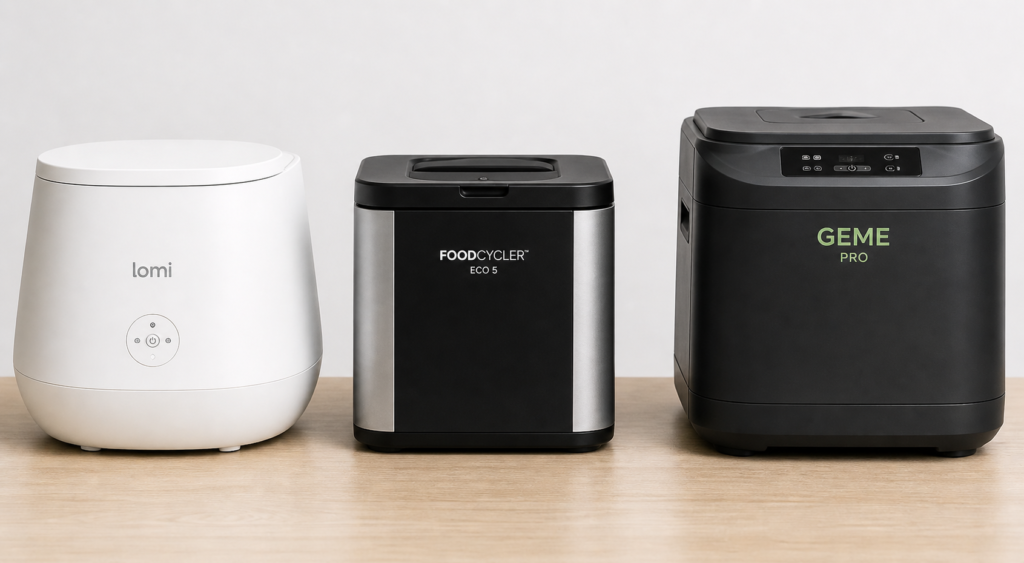
Here’s the question thousands of people type into Google every week: “Lomi vs FoodCycler vs GEME — which one should I buy?” And here’s the honest answer: it completely depends on what you’re trying to accomplish. These three machines are more different than their marketing makes them appear, and buying the wrong one is a frustrating, expensive mistake.
In this post we’ll break down every meaningful difference — price, running costs, output quality, noise, capacity, and who each machine is genuinely the best choice for. No fluff, no filler.
The Key Thing Most People Don’t Know
Lomi and FoodCycler are technically dehydrators, not true composters — they use heat and grinding to dry your food scraps. GEME uses live microbes to biologically break down waste, producing actual compost. This distinction matters enormously for how you use the output. We’ll explain it fully below.
📌 New to electric composters? Before comparing brands, you might want to read our full Best Electric Kitchen Composters of 2026 guide first — it covers all the top models and how the technology works.
#1 Best Design & Ease of Use – Lomi by Pela
★★★★☆
4.2/5 stars · The machine that started the electric composter craze
Lomi is the name that comes up first in almost every conversation about electric composters, and with good reason. Made by Pela — a brand built around sustainability — Lomi is the best-looking, most talked-about countertop composter on the market. It has a one-button operation that even children can master, and it fits neatly into virtually any kitchen aesthetic.
Lomi works in three modes: Eco-Express (3–6 hours, fastest), Lomi Approved (5–8 hours, for bioplastics too), and Grow (up to 20 hours, most nutrient-rich output). The result is a dry, crumbly material Lomi calls “Lomi Earth” — which is more accurately described as pre-compost or a soil amendment. It needs to be mixed into garden soil at roughly a 10:1 ratio before it’s ready to use.
- 3 operating modes including Grow
- 3L capacity bucket
- Sleek, award-winning design
- Can process bioplastics (Lomi Approved mode)
- Dual activated carbon filter system
- One-button operation
- Smart sensors optimise cycle time
- Dishwasher-safe bucket
The honest verdict: Lomi is the most beautiful and easiest-to-use machine in this comparison. It’s perfect if you want something simple, stylish, and low-commitment. The trade-off is the ongoing cost of filter replacements and the fact that the output isn’t true compost — it needs further processing before your garden can use it.
✅ Pros
- Most attractive design
- Simplest to operate
- Can process bioplastics
- Strong brand community & support
- Compact enough for most kitchens
❌ Cons
- Filters cost $150–$200/year
- Output is pre-compost, not true compost
- 3L capacity fills quickly for families
- Can’t add scraps during a cycle
- Struggles with high-grease foods
👉 Check Lomi Price on Amazon* As an Amazon Associate, I earn from qualifying purchases at no extra cost to you.
Due to high demand, you may not able to get it from Amazon. You can consider to purchase directly from Lomi Official Website.
#2 Best Value & Proven Track Record – Vitamix FoodCycler Eco 5
★★★★★
4.5/5 stars · Most Amazon reviews of any electric composter
The Vitamix FoodCycler Eco 5 has the most verified customer reviews of any electric composter on Amazon — and the vast majority are positive. That track record is hard to argue with. Vitamix is one of the most trusted names in kitchen appliances, and the FoodCycler reflects that reputation: it’s well-built, reliable, and does exactly what it says it will.
Like Lomi, the FoodCycler is a dehydrator-style machine. Its patented Vortech grinding system processes food scraps — including fruit pits, vegetable peels, and soft bones — into dry, granular material in 4–8 hours. The output can be mixed into garden soil as a pre-compost supplement. Where it beats Lomi is capacity (5L vs 3L) and price — it’s typically $100–$150 cheaper than Lomi, making it a significantly better deal for most households.
- 5L capacity (largest in this comparison)
- Patented Vortech grinding system
- Reduces waste by up to 90%
- Refillable carbon filter (less waste)
- Energy-efficient (less than a microwave)
- Handles pits, peels, soft bones
- Dishwasher-safe bucket
- Compact countertop footprint
The honest verdict: If the FoodCycler and Lomi are both in your shortlist, the FoodCycler wins on value almost every time. More capacity, lower price, refillable filters, and arguably better long-term reliability given Vitamix’s track record. It’s not as glamorous as Lomi, but it simply performs.
✅ Pros
- Most reviews = most proven
- Largest capacity (5L) of the three
- Refillable (not disposable) filter
- Lower price than Lomi
- Trusted Vitamix brand
❌ Cons
- Output is pre-compost, not true compost
- Less stylish than Lomi
- Can’t add scraps mid-cycle
- Filter still needs periodic replacing
- No “Grow mode” like Lomi
👉 Check FoodCycler Price on Amazon* As an Amazon Associate, I earn from qualifying purchases at no extra cost to you.
#3 Best for True Compost & Zero Running Costs – GEME Pro Electric Composter
★★★★★
Top-rated for compost quality · Zero ongoing filter costs
GEME plays a different game entirely. While Lomi and FoodCycler are dehydrators that grind and dry your food waste, the GEME Pro uses a proprietary blend of live microbes (called Kobold) to biologically decompose your food scraps — the same process that happens in an outdoor compost pile, just dramatically accelerated. The result is genuine, nutrient-rich compost that’s ready to go directly into your garden. No drying. No pre-compost. Real soil amendment.
The other headline feature: zero filter replacement costs, ever. GEME uses a permanent metal-ion oxidation catalyst for odour control — it destroys smells at a molecular level rather than absorbing them like charcoal does. Lomi owners spend $150–$200 per year on filters. GEME owners spend $0. Over three years, that’s a saving of up to $600 compared to Lomi.
- True microbial composting (not dehydrating)
- Produces real, garden-ready compost
- Permanent odour-control catalyst — $0 running costs
- 19L large capacity, up to 5kg/day
- Accepts meat, dairy, small bones
- Continuous feed — add scraps anytime
- Ultra-quiet 35–45 dB operation
- No filter replacement, ever
The honest verdict: GEME is for people who actually want to compost — not just reduce trash volume. If you have a garden, grow plants, or care about producing something genuinely useful from your food waste, GEME is the only machine in this comparison that delivers it. The higher upfront cost is offset by zero ongoing expenses.
* One Important Note *
The GEME Pro is floor-standing (about 26 inches tall) — not a countertop appliance. It’s designed to replace where your kitchen bin sits. If you have a tiny kitchen with no floor space, this is worth checking before you buy.
✅ Pros
- Only machine producing true compost
- Zero filter replacement costs
- Accepts meat, fish, dairy, bones
- Largest capacity (19L / 5kg daily)
- Add scraps anytime — continuous
❌ Cons
- Higher upfront price
- Floor-standing, not countertop
- Requires floor space
- Microbe starter pack needed initially
- Less familiar brand than Lomi
👉 Check GEME Pro Price on Amazon* As an Amazon Associate, I earn from qualifying purchases at no extra cost to you.
Side-by-Side Comparison: Every Key Spec
| Feature | Lomi | FoodCycler Eco 5 | GEME Pro |
|---|---|---|---|
| Technology | Dehydrating | Dehydrating | Live microbes |
| Output type | Pre-compost | Pre-compost | True compost |
| Capacity | 3L | 5L | 19L / 5kg daily |
| Processing time | 3–20 hrs (3 modes) | 4–8 hrs | Continuous |
| Noise level | ~45–60 dB | ~45 dB | 35–45 dB |
| Accepts meat & dairy | Limited | Limited | Yes ✓ |
| Can compost bioplastics | Yes ✓ (Lomi mode) | No | No |
| Filter cost / year | $150–$200 | $40–$60 | $0 |
| Add scraps mid-cycle | No | No | Yes ✓ |
| Footprint | Countertop | Countertop | Floor-standing |
| Design / aesthetics | Premium | Functional | Utilitarian |
| Best for | Apartments, style-conscious | Families, value buyers | Gardeners, households |
The Big Question: What Exactly Comes Out of Each Machine?
This is the most important thing to understand before you buy, and most reviews gloss over it completely. Let’s be clear about what each machine actually produces.
Lomi & FoodCycler: Pre-Compost (Dried Scraps)
Both Lomi and FoodCycler use heat and mechanical grinding to remove moisture from your food scraps. The output is dry, crumbly, and reduced in volume by up to 90%. It looks like compost and smells earthy — but it is not biologically composted material. Independent soil scientists who have tested these machines confirm that biological decomposition has not yet begun in the output.
This doesn’t mean the output is useless. Mixed into garden soil at the correct ratio, it adds organic matter and eventually breaks down into nutrients. Lomi recommends a 10:1 ratio (10 parts soil, 1 part Lomi Earth). But if you put it directly on plants or in pots, it can actually harm them by robbing nitrogen as it continues to decompose in the soil. You have to know how to use it.
GEME: True Compost
GEME uses a living culture of microbes that biologically break down your food scraps through genuine decomposition. The process is the same one that happens in an outdoor compost pile — GEME simply accelerates it dramatically using a controlled environment. The output is soil-dark, rich in nitrogen and organic matter, and ready to use directly in your garden as a proper soil amendment. Independent lab tests of GEME’s output have confirmed high levels of nitrogen and beneficial microorganisms.
🌱 Bottom Line on Output
If you just want to reduce the volume of food waste going in your bin, both Lomi and FoodCycler do that job well. If you want to actually produce compost for your plants and garden, only GEME delivers the real thing.
The True Cost of Ownership: 3-Year Comparison
The upfront price is only part of the story. Here’s what each machine actually costs to own over three years, factoring in filter replacements:
| Cost Item | Lomi | FoodCycler Eco 5 | GEME Pro |
|---|---|---|---|
| Upfront price | ~$500–$600 | ~$350–$450 | ~$500–$700 |
| Filter cost / year | $150–$200 | $40–$60 | $0 |
| Filter cost over 3 yrs | $450–$600 | $120–$180 | $0 |
| Electricity (est. 3 yrs) | ~$18 | ~$18 | ~$72 |
| Total 3-year cost (est.) | $968–$1,218 | $488–$648 | $572–$772 |
The numbers reveal something important: Lomi is by far the most expensive option over time, despite not being the most expensive to buy upfront. The FoodCycler is the cheapest option long-term, and GEME lands in the middle — with the added advantage of producing actual compost, which has real-world garden value.
Who Should Buy Which?
Choose Lomi if you…
- Live in an apartment or small space
- Want the best-looking machine on the counter
- Produce small amounts of waste (1–2 people)
- Want to process bioplastic packaging
- Prefer a well-known, supported brand
- Don’t have a garden or outdoor plants
Choose FoodCycler if you…
- Want the best value for money
- Have a medium-to-large household
- Value a proven, reliable machine
- Want the largest countertop capacity
- Want Vitamix brand reliability
- Don’t need true compost output
Choose GEME if you…
- Have a garden and want real compost
- Want to eliminate filter costs forever
- Cook meat and dairy regularly
- Have a family generating lots of waste
- Can accommodate a floor-standing unit
- Think long-term about total cost
Frequently Asked Questions
Is Lomi worth the money compared to FoodCycler?
For most buyers, the FoodCycler is the better value. It has a larger capacity, lower upfront price, cheaper filters, and equally reliable performance. Lomi’s edge is its sleeker design and the ability to process bioplastics in Lomi Approved mode — if those things matter to you, Lomi is worth the premium. If they don’t, FoodCycler wins on almost every practical metric.
Does GEME really produce real compost, or is it just marketing?
GEME genuinely uses live microbial decomposition — the same biological process as an outdoor compost pile. Independent lab tests of GEME’s output have confirmed high levels of nitrogen, organic matter, and beneficial microorganisms. This is meaningfully different from the dried, sterilised output of Lomi and FoodCycler. However, the output is a “living” compost and may still benefit from a short curing period before heavy garden use.
Can Lomi handle meat and dairy?
Lomi can handle small amounts of cooked meat and dairy in its Grow mode, but it’s not designed for it as a primary use case and the results can be inconsistent. FoodCycler similarly handles soft bones but struggles with greasy or high-dairy content. GEME is the only machine in this comparison genuinely designed to handle meat, fish, dairy, and small bones as part of its regular daily use.
How loud are these machines?
All three are quiet enough for home use. Lomi runs at approximately 45–60 dB — comparable to a refrigerator hum, noticeable in a very quiet room. FoodCycler is similar at around 45 dB. GEME is the quietest of the three at 35–45 dB, which is closer to a quiet conversation. All three can run overnight without disrupting sleep in a separate room.
Which is best for apartment dwellers?
For apartments, Lomi or FoodCycler Eco 5 are the clear choices — both are compact countertop appliances that fit comfortably on any kitchen counter. GEME is a floor-standing unit at about 26 inches tall, which can be challenging in a small apartment kitchen. If space is limited, the FoodCycler Eco 3 (smaller version) is also worth considering.
Can you add scraps to the machine while a cycle is running?
Only GEME allows continuous feeding — you can add scraps at any time because it runs a continuous biological process rather than batch cycles. Both Lomi and FoodCycler operate in batches: you fill, start a cycle, and cannot add more waste until the cycle is complete. For households that generate scraps throughout the day, GEME’s continuous operation is a significant practical advantage.
Final Verdict: Which One Should You Choose?
After comparing every meaningful dimension, here’s the bottom line:
If you want the best-looking, simplest composter for a small household or apartment — and you don’t mind the ongoing filter cost — Lomi is a genuinely satisfying appliance. It’s easy to love and easy to use.
If you want the best practical value with a proven track record, FoodCycler Eco 5 is the smart choice. More capacity, lower price, and the weight of Vitamix’s brand reliability behind it.
If you want a machine that actually composts your food waste and produces something your garden can genuinely use — with zero ongoing filter costs — GEME Pro is in a different category entirely. The higher upfront price is justified if composting is your goal rather than just waste reduction.
Whatever you choose, you’re making a positive step. Diverting food waste from landfill — in any form — reduces methane emissions and starts building better habits around the food we eat and the waste we create.